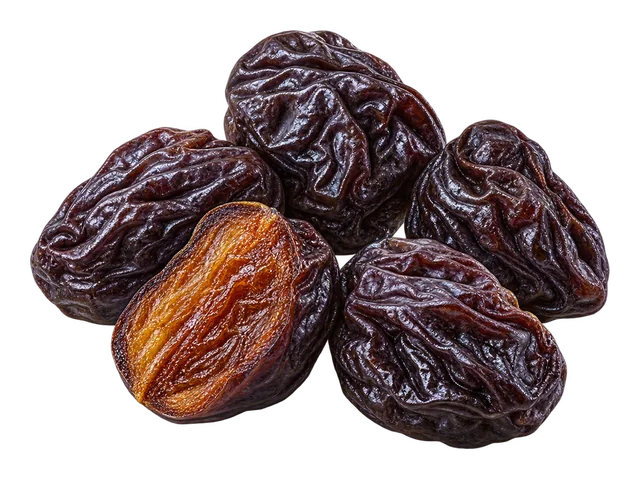
 Dried · illustration
THE FRUIT REFERENCE
Sugar in Prunes (dried plums)
Plums, dried (prunes), uncooked
View the source recordHow much sugar is in prunes (dried plums)?
The selected SR Legacy reference, “Plums, dried (prunes), uncooked”, reports 38.13g of total sugar per 100g of edible food. The headline rounds this to one decimal place.
For the source portion labelled “1 cup, pitted” (174g), that works out to 66.3g of sugar. This serving amount is calculated from the reported per-100g value.
The same record reports 63.88g of total carbohydrate and 7.1g of fiber per 100g. Total sugar is a separate reported measure; carbohydrate and sugar are not interchangeable numbers.
THE SUGAR BREAKDOWN
What is in the reference?
Reported amounts per 100g of the food described above.
- Total sugar
- 38.13 g
- Fructose
- 12.45 g
- Glucose
- 25.46 g
- Sucrose
- 0.15 g
Of fructose, glucose and sucrose, glucose is the largest reported component in this record, at 25.46g per 100g.
Individual sugars are reported separately. Missing components are not estimated, and their sum may differ from the reported total.
MAKE IT YOUR PORTION
How much are you eating?
Enter an edible food weight in grams.
Calculated from the selected per-100g reference. Serving sizes refer to edible food.
View the fruit referenceServing reference
| Portion | Edible weight | Calculated sugar |
|---|---|---|
| Reference amount | 100g | 38.1g |
| 1 cup, pitted | 174g | 66.3g |
| 1 prune, pitted | 9.5g | 3.6g |
Portion weights come from this source record. Sugar per serving is calculated, rather than a separate measurement.
Compare prunes (dried plums) with other fruits
These are equal-weight comparisons of the named source foods. Preparation, packing liquids and water content differ between these foods; compare their descriptions and portions as well as the numbers.
| Fruit | Total sugar | Reference |
|---|---|---|
| Prunes (dried plums) | 38.1g | SR Legacy · 168162 |
| Plum | 9.9g | SR Legacy · 169949 |
| Prune, dried (FNDDS 2709211) | 38.1g | FNDDS 2021-2023 · 2709211 |
Which reference does this page use?
SR Legacy describes the selected food as “Plums, dried (prunes), uncooked”. We use this legacy food record as the selected reference, keeping its original food description and reported values.
Open the linked source record for its context. A different variety, ripeness or preparation may have a different composition; we do not average unrelated records into a new value.
KEEP EXPLORING